01
Power (-56)
Civil liberty to State authority
Reads toward Civil liberty.
The library reads Mill as a profile of individual liberty: the far entrenched-rights end of the rights axis, strongly market-leaning on economy, and sceptical of state authority.
Each vector is a reading of recorded positions, not an endorsement, and nobody currently in office appears in this library. See the whole library →
Each axis is a tension rather than a good-versus-bad choice, and a reading near the centre is not a weaker answer than one at an end.
Civil liberty to State authority
Reads toward Civil liberty.
Popular rule to Expert governance
Reads toward Popular rule.
Planned economy to Free market
Reads toward Free market.
Social provision to Self-reliance
Reads toward Self-reliance.
Global integration to National sovereignty
Sits inside the centre band on this axis, so the library records no direction here.
Diplomacy to Hard power
Reads toward Diplomacy.
Progress to Tradition
Reads toward Progress.
Secular state to Religious foundation
Reads toward Secular state.
Ecological limits to Economic growth
Sits inside the centre band on this axis, so the library records no direction here.
Precaution to Acceleration
Reads toward Acceleration.
Decentralisation to Centralisation
Reads toward Decentralisation.
Majority rule to Entrenched rights
Reads toward Entrenched rights.
Score meanings and pole definitions are published on the twelve axes page.
John Stuart Mill (1806–73) is described by the Stanford Encyclopedia of Philosophy as the most influential English language philosopher of the nineteenth century. His major works include A System of Logic (1843), On Liberty (1859), Utilitarianism (1861) and An Examination of Sir William Hamilton's Philosophy (1865). He died in Avignon on 7 May 1873.
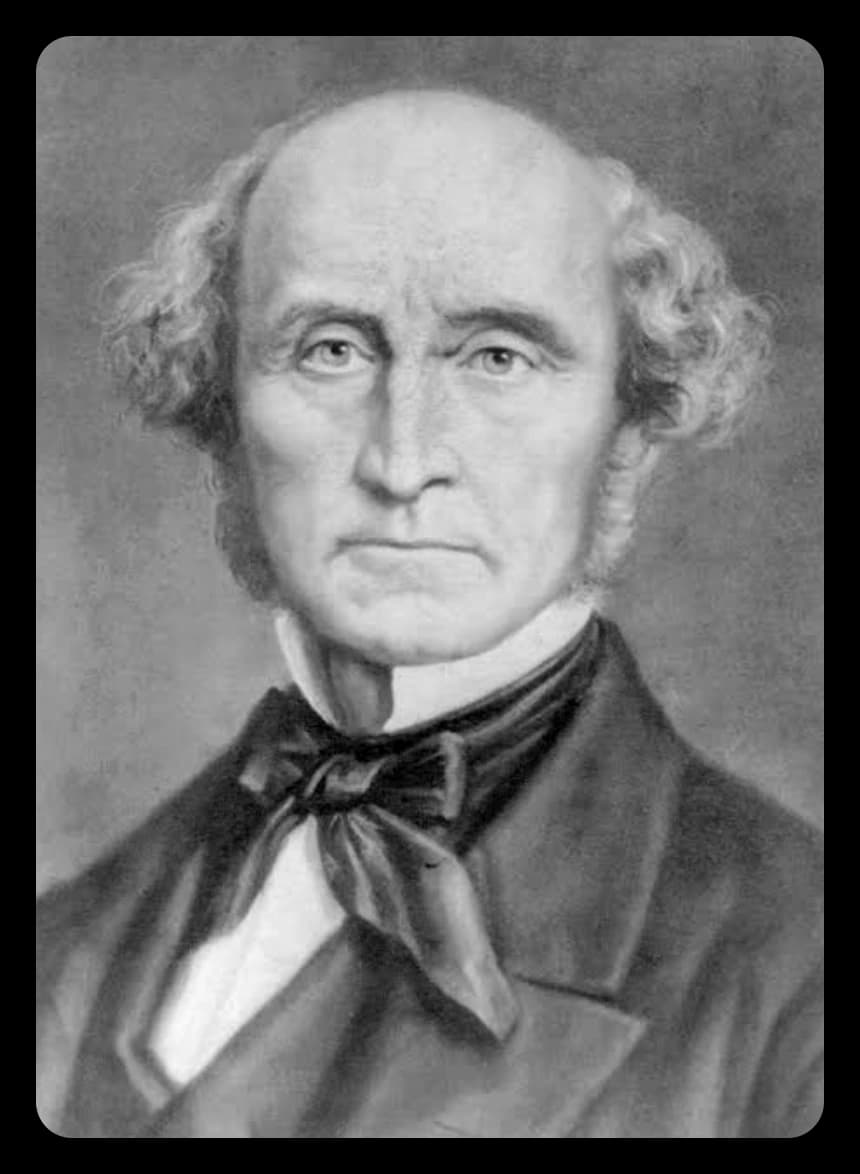
The library's portrait for this entry is a public-domain image held in the repository, as are the portraits on the rest of the historical figures set. Each one is a public-domain or openly licensed copy taken from Wikimedia Commons, and the entries whose licences require it name the artist and the licence beneath the image.
In On Liberty Mill states the limit on coercive power that the library's reading of him follows: “the only purpose for which power can be rightfully exercised over any member of a civilised community, against his will, is to prevent harm to others.”
Rights sits at the far entrenched-rights end of its axis, and economy is well toward the free-market end. Power leans toward civil liberty and force sits toward the diplomacy end, while religion and culture both lean away from their right-hand poles. Democracy and structure also lean left, and technology leans toward acceleration.
Natural rights, government by consent and a right of resistance.
Markets understood as a system of cooperation, with moral sentiment beneath the calculus.
Free expression, secular authority and contempt for established superstition.
Ordered by the same direction-only comparison the test uses to rank a profile against your answers. The library holds 53 entries in this set.
The twelve-axis vector on this page is an editorial reading of the position described, taken from the published library — not a measurement and not an endorsement.
The entry above is one position in the library. Take the test to have your own twelve scores ranked against it, or read the definitions behind each axis first.
This page describes John Stuart Mill. Every profile in the library is listed together on the combined library page, and every vector on it is written the same way this one is.